

News
Introduction: Why Underground Cable Selection Matters
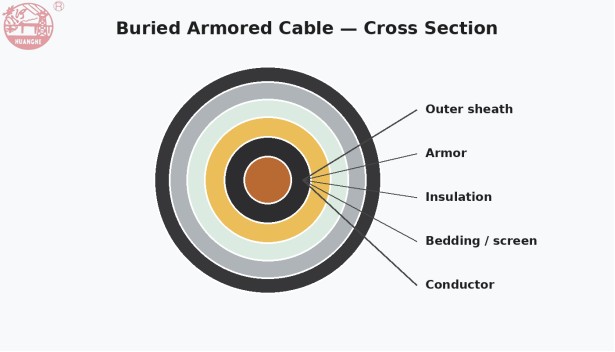
Cable construction overview
Underground power cables are one of the most important yet frequently overlooked components of modern infrastructure.
Once a cable is installed beneath roads, industrial parks, commercial developments, residential areas or utility corridors, inspection and replacement become significantly more difficult and expensive. A cable failure may require excavation, traffic management, circuit shutdowns, emergency repair and even reconstruction of finished surfaces.
For infrastructure projects planned in 2026 and beyond, cable selection should therefore focus on long-term reliability and total lifecycle cost, rather than simply choosing the lowest initial purchase price.
The right buried armored cable should be selected according to several factors: installation environment, soil and geological conditions, mechanical stress, required voltage level, cable size and conductor configuration, moisture and chemical exposure, rodent and external damage risks, installation method, applicable international standards, expected service life, and total project lifecycle cost.
A cable that performs well in one underground environment may not necessarily be the best choice in another.
Therefore, the key question is not simply: “Which armored cable is the strongest?” The better question is: “Which cable construction provides the right protection for this specific installation environment?”
1. Understand Why Armoring Is Important for Underground Cables
Underground cables can be exposed to mechanical and environmental stresses throughout their operating life.
Typical risks include mechanical pressure from backfilling and soil settlement, impact during construction, tensile forces during installation, moisture and groundwater exposure, chemical contamination, and rodent damage.
Armor is therefore not simply an additional layer. It is part of the overall mechanical protection strategy of an underground cable system.
2. Choose the Right Armor Type: STA vs SWA vs AWA
One of the most important decisions when specifying a buried armored cable is the type of armor.
The three commonly discussed constructions are STA (Steel Tape Armour), SWA (Steel Wire Armour), and AWA (Aluminium Wire Armour).
However, these armor types should not be selected simply because one is “stronger.” Their suitability depends on the cable design, conductor configuration and installation conditions.
2.1 STA Cable – Steel Tape Armored Cable
Steel Tape Armour uses steel tapes wrapped around the cable.
STA cables can provide effective protection against radial mechanical pressure and impact and are widely used in fixed installations where additional mechanical protection is required.
Typical applications may include building power distribution, industrial facilities, utility trenches, underground cable routes, commercial infrastructure, conventional buried installations, and cable ducts or protected trench systems.
STA can be an economical solution when the primary concern is protection from external mechanical damage rather than significant tensile loading.
However, engineers should always verify the exact cable standard and construction because the mechanical performance of a particular cable depends on more than the presence of armor alone.
3. SWA Cable – Steel Wire Armored Cable
Steel Wire Armour consists of steel wires applied around the cable.
One major advantage of SWA is its ability to provide mechanical protection together with useful tensile strength, making it suitable for many demanding fixed installations.
Common applications include industrial power distribution, underground utility networks, outdoor electrical systems, infrastructure projects, cable routes with greater mechanical stress, and long cable installation routes.
For projects where the cable may experience significant mechanical forces during installation or operation, SWA can be a practical option.
However, engineers should distinguish between armor providing mechanical protection and the cable being designed specifically to carry installation tensile loads. Installation procedures and manufacturer recommendations remain important.
4. AWA Cable – Aluminum Wire Armored Cable for Single-Core Cables
For large single-core AC power cables, armor selection requires special attention.
Using ferromagnetic steel armor around a single-core AC cable can result in induced currents and additional losses because of the alternating magnetic field generated by the conductor.
For this reason, Aluminium Wire Armour (AWA) is commonly used for many single-core AC cable designs.
AWA provides mechanical protection while avoiding the same type of magnetic effects associated with ferromagnetic steel armor.
Typical applications include medium-voltage power distribution, large single-core power cables, industrial power systems, utility infrastructure, substation connections, renewable energy installations, and large-scale infrastructure projects.
For single-core cable projects, armor selection should therefore be evaluated together with conductor size, AC operating current, installation arrangement, magnetic effects, cable spacing, thermal performance, and applicable standards.
5. XLPE vs PVC: Choosing the Right Insulation
For many modern power distribution projects, XLPE insulation is widely preferred because of its electrical and thermal performance.
Typical XLPE power cables are designed for a conductor operating temperature of up to 90°C under normal continuous operating conditions, subject to the applicable cable standard and installation conditions.
Compared with traditional PVC insulation systems, XLPE offers advantages such as higher continuous operating temperature, good electrical insulation properties, good resistance to thermal aging, low dielectric losses, and suitable performance for many underground applications.
A typical medium-voltage or low-voltage XLPE armored power cable may use: Copper/Aluminium Conductor → XLPE Insulation → Metallic Screen/Armor → Outer Sheath.
It would be inaccurate to claim that every PVC cable will fail after 5–8 years or that every XLPE cable will automatically operate for 25–30 years. Actual service life depends on operating temperature, load profile, installation conditions, water exposure, chemical environment, mechanical damage, manufacturing quality, installation quality, and joint and termination quality.
XLPE should therefore be considered a strong long-term insulation option, but cable service life is a system-level issue rather than an insulation-material claim alone.
6. Do Not Ignore the Outer Sheath
The outer sheath is the cable’s first major environmental barrier.
Depending on the application, cable manufacturers may use materials such as PVC, PE, MDPE, LSZH compounds, NBR, CPE, PCP/neoprene, or other specialized compounds.
The correct sheath material depends on the installation environment, including wet soil, coastal areas, industrial plants, chemical facilities, oil-contaminated environments, mining areas, wastewater facilities, and areas with high rodent activity.
Procurement teams should not specify the cable simply as “armored cable with black sheath.” The project specification should identify the required sheath material and applicable environmental performance.
7. Moisture Protection Is Critical for Buried Cables
A buried cable may encounter groundwater, rainwater, flooding, wet soil, and seasonal water-table changes.
Cable manufacturers can use different structural approaches to improve moisture resistance depending on the cable design. These may include appropriate outer sheath compounds, water-blocking materials, longitudinal water-blocking components, radial moisture barriers, suitable bedding and filling materials, and proper cable sealing.
However, the cable itself is only one part of the solution. Cable installation quality is equally important. Poor joints, damaged sheaths, incorrect terminations or inadequate drainage can create water-related failures even when the cable itself meets the required standard.
8. Consider Soil and Geological Conditions
The same cable should not automatically be used for every underground project.
Before selecting the cable, engineering teams should understand the site: soil type, ground stability, traffic exposure, flooding risk, chemical contamination, and likelihood of future excavation.
This is why cable selection should start with the installation environment, rather than starting with a product catalog.
9. Cable Size Is Not Determined by Current Alone
A correct cable selection should consider load current, voltage level, installation method, ambient temperature, soil thermal resistivity, burial depth, cable spacing, number of loaded circuits, conductor material, permitted voltage drop, short-circuit withstand capability, continuous operating temperature, and future load expansion.
For underground cables, soil thermal resistivity can have a significant effect on current-carrying capacity. Cable designers should therefore apply the relevant correction factors according to the applicable standard and actual installation conditions.
10. Pay Attention to Cable Burial Depth
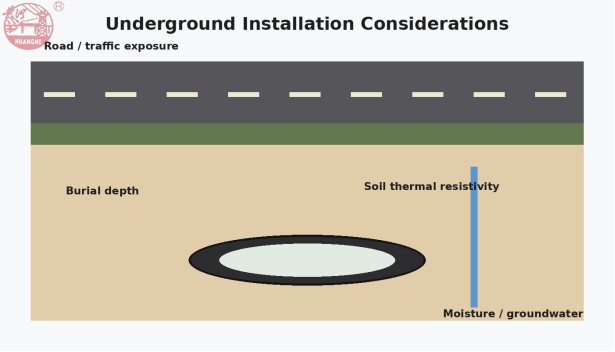
Typical underground installation factors
Installing a cable too shallow may increase exposure to mechanical impact, road construction, excavation, temperature changes, and external interference.
However, deeper burial does not automatically mean better protection. Greater depth can also affect heat dissipation, installation cost, cable pulling, maintenance access, and excavation requirements.
Burial depth should be determined according to relevant electrical regulations, project specifications, local construction requirements, and cable thermal calculations.
11. Check the Applicable Cable Standards
For international infrastructure projects, standards are essential.
IEC 60502-1 is generally applicable to power cables with extruded insulation for rated voltages up to and including 1 kV. IEC 60502-2 generally applies to power cables with extruded insulation for rated voltages above 1 kV up to and including 30 kV. BS 5467 is commonly associated with thermosetting insulated armored cables for fixed installations. IEC 60228 defines conductor classes and requirements for conductors used in insulated cables. IEC 60332 covers flame propagation tests for electrical and optical fiber cables.
The applicable standard should be selected according to the project country, voltage level, cable type and customer specification.
It is important not to assume that different standards are automatically equivalent. If a customer requests BS 5467, IEC 60502-1 or another specific standard, the supplier should confirm compliance with the exact requested standard.
12. Don't Buy Based on Armor Thickness Alone
A high-quality cable is a complete engineered system.
Procurement teams should consider conductor material, conductor class, conductor resistance, insulation material and thickness, screening requirements, bedding, armor construction and dimensions, outer sheath material and thickness, electrical performance, mechanical performance, thermal performance, and factory testing.
Two cables may both be described as “SWA armored cable” but still have different constructions and performance characteristics. Comparing the complete technical datasheet is therefore much more meaningful than comparing one parameter.
13. How to Avoid Low-Quality Armored Cables
Extremely low quotations should always be reviewed carefully.
A supplier may reduce cost by changing conductor material, conductor cross-sectional area, insulation thickness, armor dimensions, sheath thickness, raw material grade, manufacturing process, or testing procedures.
A cable may still look acceptable externally while its actual technical performance does not meet the required specification.
Procurement teams should request a technical datasheet, factory test report, certificate of quality, and type-test documentation where required.
14. Lifecycle Cost Is More Important Than Cable Unit Price
For large infrastructure projects, the purchase price of cable is only one part of the total cost.
Total Lifecycle Cost = Purchase + Installation + Maintenance + Failure Risk + Replacement Cost.
If an inexpensive cable saves 5% on the initial purchase but later requires emergency excavation, cable replacement, traffic management, labor, equipment rental, production shutdown, or customer compensation, the initial saving may become insignificant compared with the total project cost.
For critical infrastructure, reliability should be treated as an economic factor, not simply a technical factor.
15. Common Cable Selection Mistakes
Mistake 1: Choosing the cheapest cable. Better approach: Compare complete technical specifications, certifications, testing and material construction.
Mistake 2: Using the same armor for every application. Better approach: Select STA, SWA, AWA or another appropriate construction according to mechanical, electrical and installation requirements.
Mistake 3: Ignoring single-core AC cable requirements. Better approach: Evaluate aluminum armor or other appropriate non-magnetic construction where required.
Mistake 4: Looking only at conductor size. Better approach: Review the entire cable design.
Mistake 5: Ignoring soil thermal conditions. Better approach: Perform ampacity calculations using the actual installation environment.
Mistake 6: Assuming XLPE automatically means 30-year life. Better approach: Evaluate cable materials, installation, loading, environment and accessories together.
16. Practical Selection Guide for 2026 Projects
Standard underground trench: evaluate general mechanical protection and choose STA/SWA according to the project specification.
Industrial facility: consider mechanical and environmental resistance, with XLPE armored cable and suitable sheath where appropriate.
Heavy mechanical exposure: consider an appropriate SWA or other armored construction.
Single-core AC system: evaluate magnetic effects and consider AWA or suitable non-magnetic armor.
Wet underground environment: specify suitable moisture-resistant cable construction.
Chemical environment: select a sheath material with appropriate chemical resistance.
Road crossing: evaluate mechanical protection together with the installation method.
Large power transmission: verify conductor, insulation, screen, thermal and armor design.
Critical infrastructure: prioritize reliability, testing and comprehensive quality documentation.
17. A Professional Cable Selection Checklist
Electrical requirements: rated voltage, conductor material, conductor size, conductor class, current-carrying capacity, voltage drop, and short-circuit requirements.
Mechanical requirements: armor type, mechanical protection, installation tensile requirements, minimum bending radius, and burial conditions.
Environmental requirements: soil conditions, moisture exposure, chemical exposure, temperature, rodent risk, and UV exposure where applicable.
Manufacturing and quality requirements: applicable standard, technical datasheet, factory test report, type-test documentation if required, certificate of quality, raw material requirements, and production inspection.
Project and logistics requirements: required quantity, cable length per drum, drum dimensions, gross weight, delivery time, packaging requirements, destination port, and required certificates.
18. Why Cable Manufacturer Experience Matters
Choosing the right cable is not only about selecting a product from a catalog.
A professional cable manufacturer should understand the project application and recommend an appropriate construction.
For example, a request for “3 × 240 mm² XLPE armored cable for underground installation” may still require confirmation of conductor material, rated voltage, single-core or three-core construction, armor type, sheath material, required standard, installation method, quantity, drum length, destination, and special fire or environmental requirements.
A detailed technical specification helps the manufacturer provide a more accurate quotation and prevents incorrect cable selection.
19. How HUANGHE CABLE GROUP Can Support Infrastructure Projects
For large infrastructure projects, cable supply should go beyond simply providing a price.
HUANGHE CABLE GROUP can support customers with cable specification confirmation, technical datasheets, product construction information and project-oriented cable solutions.
Depending on project requirements, customers can discuss low-voltage armored power cables, medium-voltage power cables, XLPE insulated cables, PVC insulated cables, SWA cables, STA cables, AWA single-core cables, industrial power cables, underground distribution cables, and customized cable constructions.
For each project, the cable specification should be confirmed according to the required standard and actual installation conditions.
Conclusion: Choose for the Whole Project Lifecycle
Long-life buried armored cable selection should never be based on price, armor thickness or cable name alone.
The best solution is the one that matches the complete project environment.
1. Match the armor to the application. STA, SWA, AWA and other constructions have different characteristics. Select the appropriate design according to mechanical, electrical and installation requirements.
2. Select insulation and sheath materials according to the environment. XLPE is an excellent option for many modern power cable applications, while the outer sheath should be selected according to moisture, chemical, mechanical and environmental requirements.
3. Evaluate lifecycle cost. A reliable cable may have a higher initial purchase price, but reducing the risk of failure, replacement and downtime can provide significantly better long-term value.
Ultimately, the goal of a buried cable system is not simply to survive installation. It is to provide stable, reliable electrical service throughout the intended project life.
For 2026 infrastructure projects, engineers and procurement teams should therefore move from “lowest cable price” toward “best-fit cable + verified quality + lowest reasonable lifecycle risk.”
Need Help Selecting the Right Buried Armored Cable?
Choosing between STA, SWA, AWA, XLPE, PVC, PE and different sheath constructions can be difficult when the project specification is incomplete.
Contact HUANGHE CABLE GROUP with your cable type, voltage, conductor size, quantity, required standard, installation environment and destination.
Our technical team can help review the specification and recommend a suitable cable construction for your project.
HUANGHE CABLE GROUP — Professional Cable Solutions for Global Infrastructure Projects.