

News
The selection quality of waterproof rubber cables directly determines the operational safety and service life of the entire electrical system in special water related projects such as garden and water landscape supporting facilities, river construction, deep well water intake, underwater electromechanical equipment power supply, and outdoor water infrastructure. The vast majority of construction teams, project procurement, and grassroots electrical personnel commonly have industry misconceptions: they believe that rubber materials have inherent sealing and waterproof properties, and ordinary rubber sheathed cables can be used for long-term immersion in water. However, from a large number of frontline engineering cases, blindly mixing ordinary cables to replace specialized waterproof rubber cables is the main cause of insulation water leakage, conductor oxidation and blackening, line leakage tripping, equipment shutdown and scrapping. In severe cases, it can also trigger safety accidents such as electric shock, short circuit and fire. Therefore, accurately clarifying the performance boundaries between ordinary rubber sheathed cables and waterproof rubber cables, as well as standardizing selection rules for water related scenarios, is the core foundation of all underwater electrical construction and the key to avoiding engineering hazards and controlling project costs.
Before formal selection, a core engineering criterion must be clarified: ordinary rubber cables do not have the ability to withstand long-term underwater immersion and are strictly prohibited from being used in immersion conditions. The rubber sheath of conventional rubber sheathed cables only has basic rainproof and short-term moisture-proof functions. The original design intention is to adapt to dry or weakly humid scenarios such as outdoor overhead, indoor wiring, and short-term rain, without any special waterproof sealing structure. According to the measured data of IEC 60811 international standard, the insulation resistance of ordinary rubber sheathed cables is only maintained in the range of 50-100M Ω· km at room temperature of 20 ℃. Once immersed in water for a long time, water molecules will continue to penetrate the sheath and insulation layer, continuously corroding the copper core conductor, causing insulation resistance cliff like decay, abnormal voltage drop in the circuit, and frequent leakage. Under continuous water immersion conditions, ordinary rubber sheathed cables usually experience problems such as sheath cracking, core wire oxidation, and complete insulation failure within 3-5 years, which cannot meet the engineering requirements for long-term stable operation of underwater equipment.
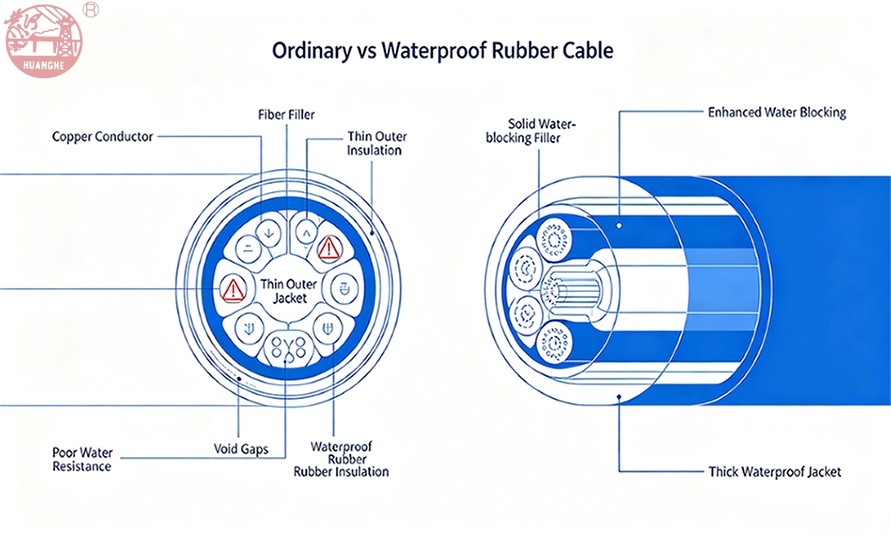
For various complex underwater working conditions, industry-specific waterproof rubber cables have completely solved the water leakage shortcomings of ordinary cables through material upgrades and structural optimizations. Currently, the mainstream universal models for engineering are JHS national standard waterproof rubber sheathed cables and H07RN8-F European standard waterproof cables, all strictly following authoritative international standards such as EN 50525-2-21 and IEC 60811. Compared to ordinary rubber sheathed cables, this type of cable uses high-density waterproof specialized rubber material, combined with a double-layer sealed sheath structure. High end models additionally add waterproof yarns and waterproof tape filling layers, forming a multi-dimensional waterproof protection system that blocks water molecule penetration from the source. Its standardized measured performance parameters are stable and compliant: insulation resistance at room temperature of 20 ℃ ≥ 20M Ω· km, can pass AC2500V/5-minute power frequency withstand voltage without breakdown test, waterproof level reaches AD8 level, supports continuous immersion without leakage for 72 hours under 0.3MPa water pressure. The official certification of the European standard H07RN8-F cable has a maximum immersion depth of 10 meters and is suitable for water temperatures ≤ 40 ℃. It is currently a compliant standard cable for shallow underwater engineering and outdoor water projects.
For engineering selection of waterproof rubber cables (such as submersible pump cables and marine engineering cables), core technical parameters directly determine their reliability and service life in underwater, high-pressure, and humid environments. Below is the core technical parameter comparison table and selection guidelines for engineering-grade waterproof rubber cables:
Engineering Selection Considerations
Dynamic vs. Static Distinction: If the cable needs to move frequently underwater (e.g., Remotely Operated Vehicles [ROVs], mining winches), models reinforced with high-strength tensile fibers (such as aramid fibers) and featuring highly flexible elastomer sheaths must be selected.
Longitudinal Water-Blocking Structure: For deep-water or long-distance laying, confirm whether the cable interior is filled with longitudinal water-blocking powder or yarn to prevent moisture from spreading longitudinally between cable cores if the outer sheath is locally damaged.
The water related engineering scenarios have a large span and significant differences in water pressure and environment. Different working conditions have completely different requirements for the pressure bearing capacity, aging resistance, and adaptation depth of waterproof rubber cables. It is necessary to select them accurately according to needs and avoid one size fits all mixing. For atmospheric and short-term shallow water scenarios (0-5 meters) such as garden landscape water features, outdoor temporary water construction, and shallow water wiring, using the national standard JHS waterproof rubber sheathed cable can meet the requirements of compliant construction and stable operation, while balancing safety performance and project cost-effectiveness. It is the preferred solution for civil and lightweight water engineering. For high-pressure and long-term immersion scenarios such as deep well submersible pumps, underwater fixed electromechanical equipment, river deepwater infrastructure, long-term underwater power supply system, etc., the reinforced deepwater waterproof rubber cable must be selected. This model can withstand 0.5MPa high water pressure, adapt to a deepwater operation environment of up to 500m, and has extremely strong hydrolysis resistance, corrosion resistance, and aging resistance, with a stable service life of more than 10 years. The entire series of waterproof rubber cables have a wide temperature resistance range, suitable for fixed installation in environments ranging from -40 ℃ to+60 ℃, and dynamic mobile installation in environments ranging from -25 ℃ to+60 ℃. The maximum underwater working temperature is limited to 40 ℃, which can easily cope with complex outdoor conditions such as alternating high and low temperatures and large temperature differences between day and night.
Scenario Selection Key Points
Dynamic Water Pressure Considerations:For scenarios involving frequent spooling, retracting, or movement (such as ROV umbilical cables and underwater operation winches), even if the water depth is relatively shallow, models equipped with tensile armor and high bending fatigue resistance must be selected in accordance with deep-sea standards.
Medium Chemical Characteristics:In sewage treatment or chemical wading environments, mere waterproof performance is insufficient to guarantee service life; emphasis must be placed on verifying the sheath material's tolerance to acids, alkalis, organic solvents, and microorganisms.
Based on national standard testing data and a large number of frontline engineering review cases, procurement and construction personnel need to focus on avoiding two major high-frequency selection errors and controlling the safe use of waterproof rubber cables from the source. Firstly, do not judge waterproof quality solely based on hand feel: many low-quality imitation waterproof cables have a soft hand feel and realistic appearance, but the material density is seriously not up to standard. The tensile strength of the sheath is less than 12MPa, and the elongation at break is less than 250%. After continuous immersion in water for 3 months, problems such as sheath bulging, water leakage, cracking and damage will occur; And compliant waterproof rubber cables strictly follow the EN 60811 mechanical performance standard, with stable wear resistance, impermeability, and tear resistance, suitable for long-term complex working conditions. Secondly, we must resolutely eliminate the money saving misconception of "replacing specialization with universality": after continuous immersion in water for 6 hours, the insulation resistance of ordinary rubber sheathed cables will plummet significantly, and the risk of leakage will increase exponentially, which completely does not meet the compliance standards for underwater construction. Seemingly reducing short-term procurement costs, it can easily lead to equipment burnout, engineering rework, safety rectification, and other issues in the future, significantly increasing the project's full lifecycle operation and maintenance costs, which is not worth the loss.
High quality waterproof rubber cables require standardized construction techniques to fully utilize their rated waterproof, pressure resistant, and aging resistant properties, effectively extending the service life of the cables. According to national and international electrical installation standards, underwater wiring must strictly control the bending radius: for fixed installations, the bending radius should not be less than 4 times the outer diameter of the cable, and for dynamic mobile installations, it should not be less than 6 times the outer diameter of the cable to avoid excessive bending and compression that can damage the sealing sheath and insulation structure. All cable connections and end positions must be double sealed and waterproofed, and direct immersion of bare wires is strictly prohibited. During the construction and laying process, it is necessary to actively avoid sharp sand, gravel, and hard edges to prevent water leakage caused by external force damage to the protective sheath. For key engineering projects that operate underwater for a long time, it is necessary to establish a regular inspection mechanism, regularly check the insulation resistance of cables, promptly identify hidden dangers such as sheath aging, interface water leakage, and line attenuation, and comprehensively ensure the long-term, safe, and stable operation of underwater electrical systems.
In summary, only specialized waterproof rubber cables that comply with national and European standards have the ability to operate under long-term underwater immersion; Ordinary rubber sheathed cables are only suitable for short-
term rainproof, regular dry and moisture-proof scenarios, and immersion operations are absolutely prohibited. All water related and underwater projects must be accurately matched with corresponding models of waterproof rubber cables based on core parameters such as immersion depth, water pressure, operation duration, and environmental temperature. At the same time, construction and daily operation must strictly comply with IEC/EN international standards. Through scientific selection, standardized construction, and regular inspections, water related electrical faults can be avoided from the source, completely solving industry pain points such as water seepage, leakage, aging and failure of underwater cables, and comprehensively ensuring the electrical safety and long-term operational stability of various water related engineering projects.