

News
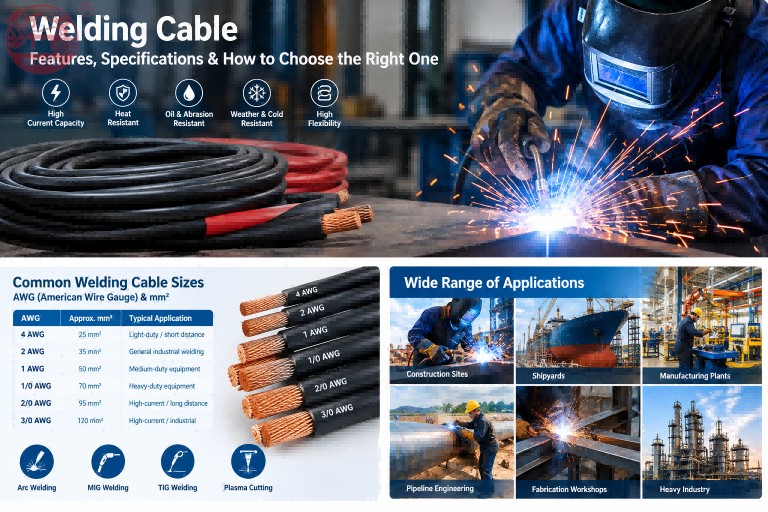
Welding cable is a specialized flexible cable designed to carry high currents in welding and related industrial applications. Unlike conventional power cables, welding cables are designed to withstand frequent bending, twisting, dragging, mechanical stress, heat, and demanding workshop environments.
Choosing the correct welding cable is important for maintaining stable welding performance, minimizing voltage drop, reducing overheating risks, and extending cable service life. The appropriate cable size depends on several factors, including welding current, duty cycle, cable length, installation conditions, and allowable voltage drop.
This guide explains the main features, common sizes, applications, selection criteria, and maintenance requirements of welding cables to help electrical engineers, welding contractors, equipment manufacturers, and industrial buyers select a suitable solution.
1. What Is a Welding Cable?
A welding cable is a high-flexibility electrical cable designed primarily for welding circuits and high-current applications. It is commonly used to connect welding machines with electrode holders, welding guns, workpieces, and grounding connections.
The conductor is normally made from stranded copper, often using numerous fine strands to provide the flexibility required for repeated movement.
Compared with ordinary fixed-installation power cables, welding cables generally have:
· Highly flexible stranded copper conductors
· Flexible rubber or elastomeric insulation and/or jacket
· Good resistance to mechanical stress
· Good resistance to heat generated during welding operations
· Flexibility for repeated bending and movement
· Suitability for temporary and mobile electrical connections
Welding cable constructions and ratings vary according to the applicable standard and manufacturer. Common standards and designations include UL, ASTM, ICEA, SAE and other national or industry-specific requirements. Buyers should always verify the applicable standard for the intended application rather than assuming that every welding cable complies with every standard.
2. Key Features of Welding Cable
2.1 Highly Flexible Stranded Copper Conductor
One of the most important characteristics of welding cable is its flexibility.
Welding cables commonly use many fine copper strands rather than a rigid solid conductor. The large number of small strands allows the cable to bend and move repeatedly without the stiffness associated with conventional fixed-installation cables.
This makes flexible welding cable suitable for:
· Welding machines
· Electrode holders
· Welding guns
· Grounding connections
· Mobile welding equipment
· Factory production lines
· Construction sites
The actual conductor construction should be checked against the manufacturer's technical data because strand diameter and stranding class can vary between cable designs.
2.2 High Current-Carrying Capability
Welding equipment can draw substantial current, particularly during high-output welding operations.
The required cable size depends not only on the welding machine's rated current but also on:
· Welding current
· Duty cycle
· Cable length
· Ambient temperature
· Installation method
· Number of energized cables
· Permitted temperature rise
· Acceptable voltage drop
Therefore, there is no single cable size that is suitable for every welding machine.
For example, a cable suitable for a short 200 A welding connection may not be appropriate for a longer connection operating at a higher current or duty cycle.
2.3 Heat Resistance
Welding environments can expose cables to elevated temperatures, hot metal surfaces, welding sparks, and radiant heat.
Depending on the cable construction, rubber and elastomeric materials such as EPDM or other specialized compounds may be used to provide flexibility and temperature resistance.
However, the maximum operating temperature should always be confirmed from the manufacturer's datasheet.
It is also important to distinguish between:
· Conductor operating temperature
· Insulation temperature rating
· Short-term exposure to external heat
· Ambient temperature
These values are not necessarily the same.
2.4 Resistance to Mechanical Stress
Welding cables are frequently moved across workshop floors and construction sites. They may be bent, coiled, dragged, or exposed to mechanical contact.
A suitable welding cable should therefore have a flexible construction and a robust outer surface appropriate for its intended environment.
For applications involving severe mechanical movement, buyers should specifically check:
· Flexibility
· Abrasion resistance
· Impact resistance
· Minimum bending radius
· Tensile resistance
· Jacket material
· Intended service conditions
2.5 Oil, Weather and Environmental Resistance
Welding cables may be used in workshops, construction sites, shipyards, manufacturing plants, and outdoor projects.
However, environmental resistance depends on the specific cable construction.
For example, one welding cable may have excellent resistance to oils and abrasion, while another may be designed primarily for flexibility and temperature performance.
For outdoor or marine applications, buyers should confirm whether the selected cable provides the required:
· UV resistance
· Weather resistance
· Water resistance
· Oil resistance
· Chemical resistance
· Low-temperature flexibility
Do not assume that every standard welding cable is automatically suitable for outdoor, marine, or oil-contaminated environments.
3. Common Welding Cable Sizes
Welding cables are available in many conductor sizes. In North American markets, sizes are commonly expressed using AWG (American Wire Gauge), while many international markets specify conductor size in mm².
Common AWG welding cable sizes include:
· 4 AWG welding cable – suitable for lower-current or shorter-distance applications
· 2 AWG welding cable – commonly used for medium-current welding applications
· 1 AWG welding cable – suitable for higher-current applications
· 1/0 AWG welding cable – commonly selected for heavy-duty welding applications
· 2/0 AWG welding cable – used for higher-current applications
· 3/0 AWG welding cable – suitable for certain high-current and longer cable runs
Important: AWG Numbering
A common misunderstanding is that a larger AWG number means a larger conductor.
In fact, AWG works in the opposite direction:
The smaller the AWG number, the larger the conductor cross-sectional area.
For example:
4 AWG < 2 AWG < 1 AWG < 1/0 AWG < 2/0 AWG
in terms of conductor size.
Therefore, 2 AWG is larger than 4 AWG, and 1/0 AWG is larger than 1 AWG.
For international projects, it is often more convenient to specify welding cable directly in mm², such as 25 mm², 35 mm², 50 mm², 70 mm², 95 mm², or 120 mm², depending on the required application.
4. Welding Cable Current Capacity
The current-carrying capacity of a welding cable cannot be determined from conductor size alone.
For welding applications, the duty cycle is particularly important.
A welding machine may operate at its maximum current for only a portion of the operating cycle. Consequently, the permissible cable current can differ from the continuous current rating used for other types of electrical installations.
When selecting a welding cable, consider:
For safety and accurate sizing, the cable manufacturer's current-rating data should be used together with the welding-equipment manufacturer's requirements.
5. Main Applications of Welding Cables
Flexible welding cables are widely used in industrial and commercial environments.
Typical applications include:
Arc Welding
Used for connecting welding power sources, electrode holders, and workpieces in various arc-welding systems.
MIG Welding
Flexible welding cables can be used in suitable MIG welding equipment and connection systems, subject to the equipment manufacturer's requirements.
TIG Welding
Welding cables may be used for power and workpiece connections in TIG welding systems.
Construction Sites
Portable welding equipment often requires flexible cables capable of handling repeated movement and temporary installation.
Shipyards and Marine Workshops
Welding cables are frequently used around shipbuilding and repair operations. For marine environments, however, the cable must have environmental properties appropriate to the specific marine application.
Automotive and Manufacturing Plants
Welding cables are used in production environments where equipment and cables may be repeatedly moved.
Heavy Industrial Equipment
Industrial fabrication, steel processing, pipeline construction, and equipment maintenance can all require flexible high-current welding connections.
6. How to Choose the Right Welding Cable
Selecting the correct welding cable requires more than simply matching the cable size to the welding machine.
6.1 Match the Cable Size to Welding Current
First determine the welding machine's maximum operating current.
Then consider the duty cycle and actual operating conditions.
For example, a cable used with a low-current portable welding machine may have very different requirements from a cable used continuously with a high-current industrial welding system.
Do not select a cable based solely on the welding machine's maximum amperage.
6.2 Consider Cable Length and Voltage Drop
Cable length has a direct effect on electrical resistance and voltage drop.
As the cable becomes longer, resistance increases. This can result in greater voltage drop and power loss.
For long welding cable runs, consider:
· Increasing conductor size
· Reducing unnecessary cable length
· Checking the allowable voltage drop
· Confirming the welding equipment's operating requirements
There is no universal rule that every cable longer than 15 or 20 meters must be upgraded by one particular AWG size. The correct size should be calculated according to current, conductor resistance, cable length, duty cycle, and the acceptable voltage drop.
6.3 Choose the Appropriate Insulation and Jacket
The insulation and outer jacket should match the working environment.
Common considerations include:
· EPDM or other rubber compounds for flexibility
· Temperature resistance
· Abrasion resistance
· Oil resistance
· UV resistance
· Weather resistance
· Low-temperature flexibility
For standard workshop applications, a flexible rubber-insulated welding cable may be appropriate.
For outdoor, marine, mining, or other demanding environments, a specialized cable construction may be required.
6.4 Check the Required Standard
Before purchasing welding cable, confirm the required standard and certification.
Depending on the project and market, specifications may refer to:
· UL
· ASTM
· ICEA
· SAE
· IEC
· Customer-specific technical specifications
The applicable standard should be confirmed based on the project requirements. A cable should not be described as "UL, SAE and IEC compliant" unless the specific product has actually been designed, tested, and certified according to the applicable requirements.
7. Welding Cable vs. Ordinary Power Cable
Welding cable and ordinary power cable are designed for different applications.
Using a conventional fixed-installation cable in an application requiring continuous bending or movement can result in premature mechanical failure.
8. Welding Cable Maintenance Tips
Proper handling can significantly extend the service life of welding cables.
Avoid Excessive Dragging
Do not repeatedly drag the cable over sharp edges, rough surfaces, or hot metal.
Avoid Excessive Bending
Follow the manufacturer's recommended minimum bending radius.
Inspect the Cable Regularly
Check for:
· Cracked insulation
· Cuts
· Abrasion
· Exposed conductor
· Burn marks
· Loose terminals
· Damaged connectors
Prevent Overheating
Avoid operating the cable beyond its recommended current or duty cycle.
If the cable becomes unusually hot during normal operation, inspect the cable size, connections, load, and operating conditions.
Store Properly
When not in use, coil the cable without creating sharp bends and store it in a suitable dry environment.
9. Frequently Asked Questions About Welding Cable
Q1: What is the difference between welding cable and battery cable?
Welding cable and battery cable can both use flexible stranded copper conductors, but they are designed and specified for different applications.
Welding cable is specifically intended for welding circuits and is typically optimized for high flexibility and repeated movement.
Battery cable is designed primarily for battery and vehicle electrical connections.
The correct choice should be based on the required current, flexibility, insulation, environmental conditions, and applicable standard rather than assuming that one can universally replace the other.
Q2: Can welding cable be used outdoors?
Some welding cables are suitable for outdoor applications, but not every welding cable is automatically weatherproof or UV-resistant.
For outdoor use, check the manufacturer's specifications for:
· UV resistance
· Weather resistance
· Temperature range
· Water resistance
· Mechanical durability
For permanent outdoor installations, use a cable specifically designed and approved for that environment.
Q3: Does welding cable length affect performance?
Yes.
Increasing cable length increases electrical resistance and therefore can increase voltage drop and power loss.
For longer cable runs, a larger conductor may be required depending on the welding current, duty cycle, and allowable voltage drop.
Q4: Is EPDM the best insulation material for welding cable?
EPDM is a widely used material for flexible rubber cables because it can provide good flexibility, temperature performance, and resistance to environmental aging.
However, it should not automatically be described as the "best" material for every application.
The appropriate insulation or jacket depends on the required:
· Temperature rating
· Flexibility
· Oil resistance
· Abrasion resistance
· UV resistance
· Chemical resistance
· Environmental conditions
Q5: What welding cable size do I need for my welding machine?
The required size depends on more than the machine's rated current.
You should provide:
1. Welding current (A)
2. Duty cycle (%)
3. Cable length (m)
4. Welding machine type
5. Indoor or outdoor application
6. Required standard
7. Ambient temperature and installation conditions
With this information, the appropriate cable size can be determined more accurately.
10. Conclusion
Choosing the right welding cable is essential for reliable welding performance, safe equipment operation, and long-term cable service life.
Before selecting a welding cable, users should consider several key factors, including:
· Conductor cross-sectional area
· Welding current
· Duty cycle
· Cable length
· Voltage drop
· Cable flexibility
· Temperature rating
· Mechanical resistance
· Environmental conditions
· Applicable standards
A properly selected welding cable can help reduce overheating, minimize voltage losses, improve equipment reliability, and withstand the repeated bending and mechanical movement associated with welding operations.
Welding Cable Solutions from Huanghe Cable Group
Huanghe Cable Group is a professional cable manufacturer and exporter providing cable solutions for international industrial, construction, engineering, and equipment-manufacturing projects.
We can provide welding cable solutions in different conductor sizes, flexible constructions, insulation materials, cable lengths, and packaging configurations according to customer requirements.
Our team can also review project-specific technical requirements, including:
· Welding current
· Cable size
· Cable length
· Required quantity
· Operating environment
· Required standard
· Packaging requirements
· Destination country or port
For distributors, engineering contractors, industrial equipment manufacturers, and large-volume buyers, Huanghe Cable Group can discuss customized cable specifications according to the actual application.
Need a Welding Cable Quotation?
If you are looking for flexible welding cable for industrial or commercial applications, send us your cable specifications, required quantity, application, and destination.
Huanghe Cable Group will review your requirements and provide a suitable cable specification and quotation for your project.