

News
Building wire is one of the most widely used electrical wiring solutions in residential buildings, commercial facilities, and construction projects. It is commonly used for lighting circuits, socket outlets, distribution systems, control circuits, and fixed wiring installed in conduits, walls, ceilings, and other building structures.
Choosing the right building wire requires more than simply selecting a conductor size. Conductor construction, insulation material, voltage rating, temperature rating, installation environment, flexibility, applicable standards, and local electrical codes all need to be considered.
Among the commonly encountered building-wire types are BV, BVR, THHN, and THWN. Although these products are all used for building electrical installations, they are designed according to different standards and have different construction and application characteristics.
This guide explains the key differences between these building wires and provides practical guidance for selecting the appropriate product for residential, commercial, and general construction applications.
1. What Is Building Wire?
Building wire is an insulated electrical wire designed primarily for fixed electrical installations in buildings and similar applications.
Depending on the product and applicable standard, building wire may use a solid or stranded copper conductor with PVC, thermoplastic, nylon-coated, or other suitable insulation systems.
Typical applications include:
Residential electrical wiring
Commercial building wiring
Lighting circuits
Socket and receptacle circuits
Distribution boards
Conduit wiring
Ceiling and wall wiring
Control and auxiliary circuits
Building wires are generally intended for fixed installation rather than applications requiring continuous movement, such as cranes, festoon systems, or portable equipment.
The correct product should always be selected according to the applicable electrical code, installation method, environmental conditions, and manufacturer's technical specification.
2. Common Types of Building Wire
2.1 BV Building Wire
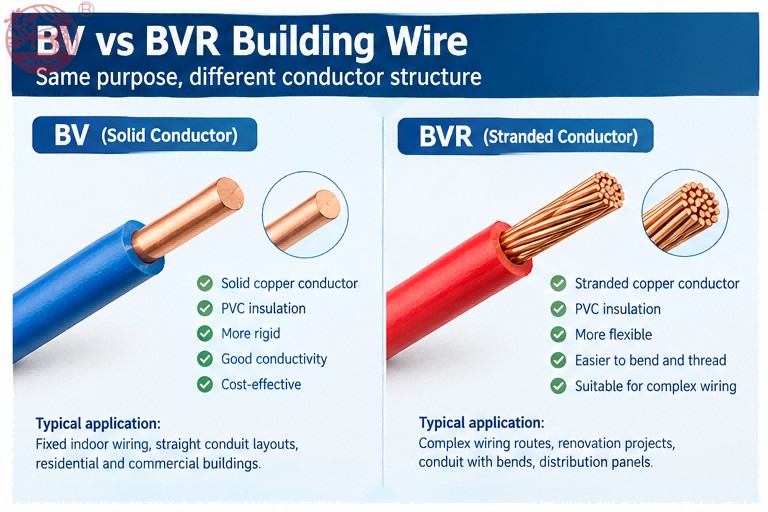
BV is a commonly used designation for a single-core copper conductor with PVC insulation in Chinese/IEC-oriented cable markets. Depending on the applicable standard and product construction, the conductor may be solid or stranded.
For typical solid-conductor BV products, the relatively rigid construction makes them suitable for fixed wiring installations where the cable does not need frequent movement.
Key Features
Copper conductor
PVC insulation
Commonly used for fixed installations
Available in various conductor sizes
Suitable for installation in conduit and other approved wiring systems
Good electrical and mechanical performance when correctly selected and installed
Typical Applications
BV-type wires are commonly used for:
Residential wiring
Lighting circuits
Socket circuits
Distribution-board wiring
Fixed conduit installations
Commercial and general building wiring
For projects requiring frequent bending during installation, a stranded construction may be more convenient.
BV vs BVR building wire conductor comparison
2.2 BVR Building Wire
BVR is generally used to describe a flexible, stranded copper conductor with PVC insulation in Chinese/IEC-oriented cable markets.
Compared with a solid conductor, the multiple-wire stranded construction provides greater flexibility, making BVR particularly useful where the wiring route includes bends or where easier installation is required.
Key Features
Stranded copper conductor
PVC insulation
Greater flexibility than typical solid-conductor building wire
Easier installation through conduit
Suitable for fixed electrical installations requiring additional flexibility
Typical Applications
BVR is commonly considered for:
Building electrical wiring
Distribution panels
Control cabinets
Conduit installations with multiple bends
Electrical equipment connections
Renovation projects
BVR should not be confused with cables designed for continuous flexing or repeated mechanical movement. Its suitability depends on the specific product construction and installation requirements.
2.3 THHN Building Wire
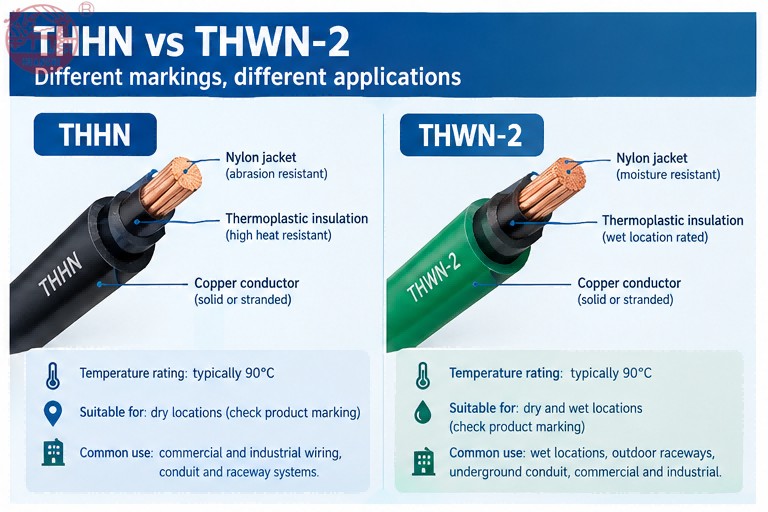
THHN is a North American wire designation commonly encountered in building and industrial electrical installations.
THHN stands for:
Thermoplastic High Heat-resistant Nylon-coated
THHN wire generally incorporates thermoplastic insulation with a nylon or equivalent protective coating and is designed for applications where the applicable product marking and installation requirements permit its use.
A typical THHN conductor is copper or aluminum, depending on the product, and is commonly installed in raceways, conduits, or other approved wiring systems.
Key Features
Thermoplastic insulation system
Nylon or equivalent protective coating
Good abrasion resistance
Suitable for many conduit and raceway installations
Available in a wide range of conductor sizes
Designed according to applicable North American electrical standards
Typical Applications
THHN wire is widely used in:
Commercial buildings
Industrial facilities
Distribution systems
Conduit and raceway installations
Electrical panels
General power and lighting circuits
The actual ampacity and permissible application depend on conductor size, installation method, ambient conditions, and the applicable electrical code.
2.4 THWN and THWN-2 Building Wire
THWN is another North American wire designation. The W indicates suitability for use in wet locations when the product is properly marked and installed according to the applicable requirements.
THWN products are therefore commonly selected for wiring systems where exposure to moisture or wet locations is possible.
Many modern products carry combined markings such as THHN/THWN-2, meaning that the same wire has been evaluated and marked for the corresponding applications.
Key Features
Thermoplastic insulation system
Suitable for approved wet-location applications
Good resistance to moisture
Suitable for conduit and raceway installations
Available in various conductor sizes
Commonly used in commercial and industrial electrical systems
Typical Applications
THWN or THWN-2 wires may be used for:
Wet-location conduit systems
Outdoor raceways where the product marking permits
Underground conduit systems
Commercial buildings
Industrial electrical installations
Areas where moisture exposure is possible
The exact temperature rating and permitted applications should always be confirmed from the wire marking and manufacturer's datasheet.
THHN and THWN-2 building wire structure
3. BV vs BVR vs THHN vs THWN
Although these four wire types can all appear in building electrical projects, they should not be treated as direct equivalents.
Important Note
The table above is a general comparison rather than a statement that one wire type is universally interchangeable with another.
Electrical wire designations are linked to specific standards and certification systems. Before substitution, engineers should verify the standard, voltage rating, conductor size, temperature rating, insulation system, certification, and installation method.
4. How to Select the Right Building Wire
Choosing a suitable building wire requires consideration of several factors.
4.1 Consider the Installation Environment
Dry Indoor Areas
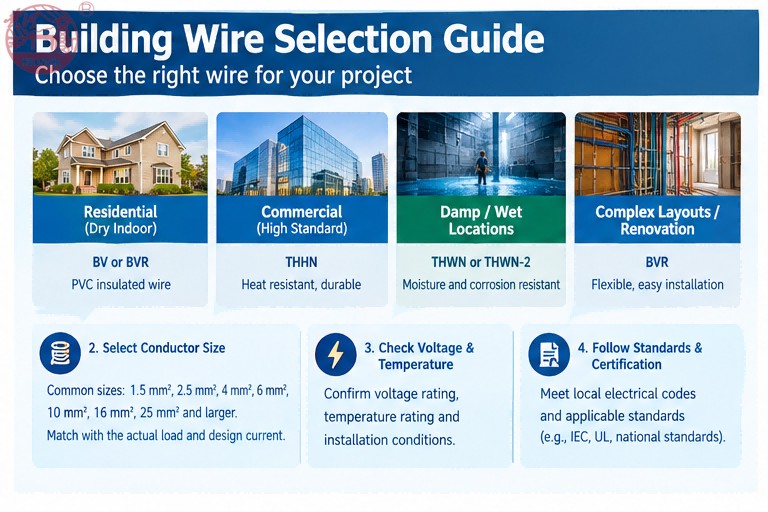
For standard indoor fixed wiring, PVC-insulated building wires such as BV or BVR may be appropriate when permitted by the applicable electrical standard.
BV can be suitable where a relatively rigid conductor is convenient, while BVR can provide easier installation where additional flexibility is beneficial.
Areas Requiring Greater Flexibility
For wiring routes with numerous bends, BVR or another appropriately flexible construction may simplify installation.
However, ordinary building wire should not automatically be used for applications involving continuous movement or repeated flexing.
Damp or Wet Locations
Where moisture exposure is expected, the selected wire must have an appropriate wet-location rating.
In North American systems, THWN or THWN-2 marked wire may be used where the applicable code permits it.
For other standards, the corresponding cable designation should be selected according to the relevant national or international requirements.
Building wire selection guide for residential and commercial wiring
5. Select the Correct Conductor Size
Conductor cross-sectional area is one of the most important factors in building-wire selection.
Common metric building-wire sizes include:
1.5 mm², 2.5 mm², 4 mm², 6 mm², 10 mm², 16 mm², 25 mm² and larger.
However, conductor size should not be selected solely according to the electrical appliance's rated power.
Engineers should consider:
Design current
Installation method
Ambient temperature
Number of loaded conductors
Permitted voltage drop
Short-circuit conditions
Conductor material
Insulation temperature rating
Local electrical regulations
For example, smaller conductors are commonly used for lighting and general circuits, while larger conductors may be required for high-power equipment, air-conditioning systems, feeders, and distribution circuits.
The final conductor size should always be determined according to the applicable electrical code and project design.
6. Check Voltage and Temperature Ratings
Building wire must have a voltage rating suitable for the intended electrical system.
Temperature rating is equally important because conductor ampacity and permissible operating conditions depend on the applicable insulation system and installation conditions.
For example, North American THHN/THWN-2 products may have different temperature ratings depending on the application and product marking.
Therefore, instead of comparing wire types solely by a nominal temperature number, buyers should check the complete product specification and applicable standard.
7. Check Applicable Standards and Certifications
Building wire standards vary significantly between regions.
For projects using IEC-based specifications, the purchaser may encounter designations such as BV and BVR together with relevant IEC, national, or regional standards.
For North American projects, THHN and THWN/THWN-2 wires are commonly associated with UL and applicable electrical-code requirements.
Before purchasing, confirm:
Applicable standard
Certification requirements
Voltage rating
Conductor material
Conductor class
Insulation material
Temperature rating
Wet/dry location requirements
Flame and smoke requirements where applicable
Required markings
This is particularly important for international projects because a wire meeting one regional standard should not automatically be assumed to be equivalent to a product manufactured to another standard.
8. Building Wire Installation Tips
Correct installation is essential for achieving reliable electrical performance.
8.1 Follow the Permitted Installation Method
Install the wire according to the applicable electrical code and manufacturer's instructions.
Do not use a building wire in applications for which it has not been designed or certified.
8.2 Avoid Excessive Mechanical Stress
Avoid excessive pulling force, sharp bends, crushing, or other mechanical damage during installation.
The minimum bending radius specified by the manufacturer should be respected.
8.3 Use Appropriate Conduit or Raceway Systems
Where conduit or raceway installation is required, use an appropriate system and avoid overcrowding.
Proper installation also helps facilitate future inspection and maintenance.
8.4 Use Correct Identification
Follow the applicable local color-coding and identification requirements for line, neutral, protective earth, and other conductors.
Color conventions can vary between countries, so the project's applicable electrical standard should always be followed.
8.5 Avoid Circuit Overloading
A conductor should not be operated beyond its permitted ampacity.
Circuit protection must also be properly coordinated with the conductor size and installation conditions.
9. Common Questions About Building Wire
Q1: What is the difference between BV and BVR?
The main difference is conductor construction.
BV is commonly associated with PVC-insulated copper building wire and may be supplied with a solid conductor depending on the product specification. BVR generally uses a stranded copper conductor, providing greater flexibility.
The appropriate choice depends on the installation method and applicable standard.
Q2: Is BVR more flexible than BV?
Generally, yes, when comparing BVR stranded construction with solid-conductor BV.
The multiple-wire conductor structure allows BVR to bend more easily, which can be useful in conduit routes with bends or complicated installation conditions.
However, BVR should not automatically be considered a continuous-flex cable.
Q3: Can THHN be used in wet locations?
Do not determine wet-location suitability from the THHN designation alone.
A wire marked only THHN should not automatically be assumed to have a wet-location rating. Many products are marked THHN/THWN-2, providing additional approved applications.
Always check the complete wire marking and applicable code requirements.
Q4: Can THWN be used in dry locations?
Yes, where the product's complete marking and applicable standard permit it.
Many THWN-2 products are dual-rated and are used in both dry and wet locations.
Q5: Can building wire be used outdoors?
It depends on the specific product and installation method.
Standard indoor building wire should not automatically be exposed directly to outdoor weather. Outdoor applications may require products with appropriate sunlight, moisture, temperature, and environmental ratings.
Always verify the product marking and installation requirements before outdoor use.
Q6: How long does building wire last?
There is no single service-life figure that applies to every building wire.
Actual service life depends on factors including:
Operating temperature
Electrical loading
Installation quality
Moisture exposure
Chemical exposure
Mechanical stress
UV exposure
Insulation material
Environmental conditions
Properly selected and correctly installed building wire can provide long-term service, but its expected service life should be evaluated according to the specific product and installation environment.
Huanghe Cable Group building wire and house wiring cable
10. Building Wire Solutions from Huanghe Cable Group
Huanghe Cable Group supplies a range of building and electrical wiring products for residential, commercial, industrial, and infrastructure applications.
Our product offering can be configured according to project requirements, including different:
Conductor sizes
Conductor constructions
Insulation materials
Colors
Voltage ratings
Packaging options
Applicable standards
For international projects, customers should provide the required standard, conductor size, voltage rating, quantity, installation environment, and destination market so that the appropriate cable specification can be confirmed before quotation.
For projects requiring BV, BVR, or other building-wire constructions, Huanghe Cable Group can provide technical datasheets and relevant product documentation for review.
11. Conclusion
Building wire selection should be based on the actual electrical and installation requirements rather than simply choosing the most commonly used wire type.
BV is commonly used for fixed building wiring, while BVR provides greater flexibility through its stranded conductor construction. THHN and THWN/THWN-2 are North American wire designations with specific construction and application requirements, including different considerations for dry and wet locations.
Before placing an order, engineers and electrical contractors should verify the conductor size, voltage rating, temperature rating, insulation system, installation method, environmental conditions, applicable standard, and certification requirements.
By matching the wire construction to the project requirements, building owners, contractors, and electrical professionals can achieve reliable electrical performance and long-term installation quality.