
News
Updated: November 2026 | Huanghe Cable Group
Key Takeaways
Are you sourcing low-voltage (LV) armoured power cables for commercial buildings, industrial facilities, infrastructure projects or EPC developments in Malaysia?
Choosing the right armoured cable involves more than comparing prices per metre. Buyers need to verify cable construction, conductor materials, insulation, armour type, applicable IEC standards, certification scope, production requirements and delivery terms.
This guide helps Malaysian electrical contractors, EPC companies, distributors and cable importers:
· Understand the differences between SWA, AWA and STA armoured cables.
· Compare PVC and XLPE insulation for LV applications.
· Interpret common cable descriptions and BOQ specifications.
· Check IEC 60502-1 compliance and certification documentation.
· Understand Malaysian electrical equipment approval requirements.
· Prepare complete RFQs and compare supplier quotations accurately.
Huanghe Cable Group provides factory-direct LV armoured cable solutions for international projects, with product specifications and supporting documents confirmed according to individual project requirements.
1. Introduction: Understanding LV Armoured Cable Requirements in Malaysia
Low-voltage armoured power cables are widely used in commercial buildings, manufacturing facilities, industrial plants, infrastructure developments and power distribution networks.
Common applications include:
· Underground power distribution.
· Cable duct and trench installations.
· Industrial power supply systems.
· Commercial building electrical installations.
· Outdoor cable routes and industrial cable trays.
For many Malaysian projects, 0.6/1kV armoured cables are specified for fixed electrical installations where mechanical protection is required.
The appropriate cable construction depends on several factors, including conductor material, core configuration, insulation type, installation environment, mechanical protection requirements and project standards.
Huanghe Cable Group: LV Armoured Cable Manufacturing
Huanghe Cable Group manufactures low-voltage power cables for international commercial, industrial and infrastructure projects.
Our LV armoured cable product range includes:
· Copper conductor armoured cables.
· Aluminium conductor armoured cables.
· XLPE-insulated armoured power cables.
· PVC-insulated armoured power cables, subject to product availability and certification scope.
· Single-core and multi-core cable configurations.
· Steel Wire Armour (SWA), Aluminium Wire Armour (AWA) and Steel Tape Armour (STA) constructions, subject to design and production confirmation.
For projects specifying IEC 60502-1, cable construction, dimensions, materials and testing requirements are confirmed against the applicable standard and project specifications.
Our objective is to help buyers clarify technical requirements before quotation and reduce specification discrepancies during procurement and production.
2. Understanding LV Armoured Cable Construction and Codes
Malaysian BOQs, electrical drawings and supplier catalogues frequently use abbreviated cable descriptions.
Common examples include:
· Cu/XLPE/SWA/PVC
· Al/XLPE/SWA/PVC
· Cu/PVC/SWA/PVC
· Cu/XLPE/AWA/PVC
These descriptions provide an overview of cable construction, but they may not specify every technical detail required for manufacturing and procurement.
2.1 How to Read Armoured Cable Construction
A typical XLPE-insulated, SWA-armoured cable consists of the following layers:
Conductor → Insulation → Inner Sheath / Bedding → Armour → Outer Sheath
For example:
Cu/XLPE/PVC Bedding/SWA/PVC
· Cu: Copper conductor.
· XLPE: Cross-linked polyethylene insulation.
· PVC Bedding: Polyvinyl chloride inner sheath or bedding.
· SWA: Steel Wire Armour.
· PVC: Polyvinyl chloride outer sheath.
Buyers should not rely exclusively on abbreviated cable codes. Always request a detailed datasheet or cable construction drawing to confirm the complete structure.
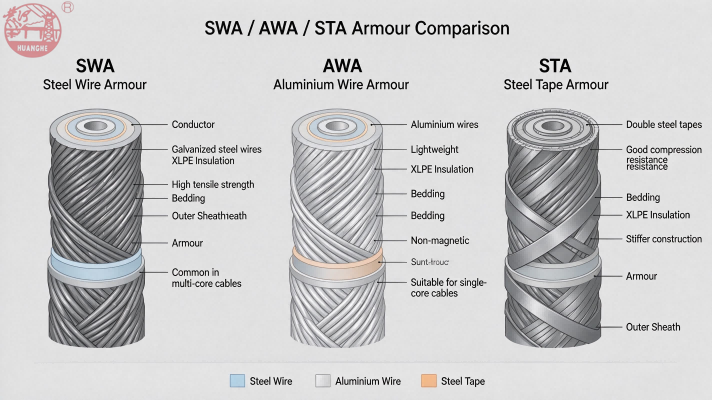
2.2 SWA vs AWA vs STA: Which Armour Type Should You Choose?
Armour selection is one of the most important considerations when sourcing LV power cables.
Different armour constructions provide different mechanical properties and are suitable for different cable configurations and installation conditions.
Steel Wire Armour (SWA)
SWA provides mechanical protection and is widely used in multi-core power cables for industrial, commercial and underground installations.
Aluminium Wire Armour (AWA)
AWA is a non-magnetic armour option commonly used for single-core AC power cables.
Conventional ferromagnetic steel armour should generally not be specified for single-core AC circuits without an appropriate engineering assessment. Induced currents can cause additional losses and overheating.
Steel Tape Armour (STA)
STA uses steel tapes to provide mechanical protection. It is commonly adopted in certain multi-core cable designs, depending on the required construction and installation conditions.
Procurement Recommendation:
When requesting a quotation, specify the cable core configuration, operating voltage, installation method and required armour type. Do not assume that SWA, AWA and STA are interchangeable.
2.3 PVC vs XLPE Insulation: Key Differences for LV Cable Procurement
Insulation material affects a cable's thermal performance, electrical properties and current-carrying capacity.
PVC and XLPE are two commonly used insulation materials in LV power cable manufacturing.
Temperature ratings are typical values for commonly specified compounds and must be confirmed against the applicable cable standard and product datasheet.
XLPE-insulated cables are frequently selected for projects requiring a 90°C continuous conductor operating temperature.
PVC and XLPE cables should not be substituted for one another without checking the project specifications, applicable standards and engineering approval.
For procurement purposes, buyers should confirm:
· Insulation material and grade.
· Nominal insulation thickness.
· Rated voltage.
· Maximum conductor operating temperature.
· Applicable manufacturing and testing standards.
3. IEC Standards and Malaysian Cable Compliance Requirements
International standards provide a common technical reference for cable design, manufacturing and testing.
However, compliance with an IEC standard and approval for importation or sale in Malaysia are two different matters.
3.1 Important IEC Standards for LV Armoured Cables
The following standards are relevant to common LV power cable procurement:
Not every project requires every standard listed above.
Buyers should identify the exact standards specified in the tender documents and confirm the corresponding product and test requirements before placing an order.
3.2 Understanding IECEE CB Certification
The IECEE CB Scheme is an international system for the mutual recognition of test results and certification documentation based on applicable IEC standards.
For cable procurement, an IECEE CB Test Certificate and its associated test report can support technical evaluation and product compliance assessment.
However, buyers should understand several important points:
· A CB certificate applies to the products and specifications within its stated scope.
· It does not automatically cover every cable manufactured by the same factory.
· It does not automatically replace Malaysian regulatory approval.
· Project consultants and end users may have additional documentation or inspection requirements.
When reviewing a manufacturer's CB documents, check:
1. Certificate holder and manufacturing location.
2. Applicable IEC standard and edition.
3. Product category and construction.
4. Conductor material and rated voltage.
5. Core configuration and size range.
6. Certificate validity and supporting test report.
Huanghe Cable Group can provide relevant product certification documents for applicable product models, subject to verification of the exact certificate scope.
3.3 Malaysian Regulatory Requirements: ST, ECoS and SIRIM
Malaysia has specific regulatory procedures for certain electrical equipment.
Buyers should distinguish between:
· International product standards.
· IECEE CB certification.
· Malaysian regulatory approvals.
· Project-specific technical acceptance.
Peninsular Malaysia: Suruhanjaya Tenaga (ST)
The Energy Commission (ST) regulates electrical equipment under the applicable Malaysian electricity legislation and approval guidelines.
A Certificate of Approval (CoA) is required for equipment falling within the relevant regulated categories and applicable requirements.
ST's published list includes certain non-armoured wires, cables and cords within specified size ranges. However, buyers should not assume that all armoured cables are automatically exempt from every applicable regulatory requirement.
The exact product classification, intended use and applicable import requirements should be checked against the latest official ST guidelines.
Sabah: Energy Commission of Sabah (ECoS)
ECoS became the permit-issuing agency for regulated electrical and electronic equipment imported into Sabah from 3 January 2024.
Importers of regulated equipment are required to follow the applicable Certificate of Registration (CoR) and Certificate of Approval (CoA) procedures.
SIRIM QAS International acts as a registered Conformity Assessment Body under the ECoS framework.
SIRIM
SIRIM QAS provides conformity assessment and related testing and certification services.
Its involvement depends on the applicable regulatory procedure, product category and project requirements.
Important for Malaysian Importers:
Before shipment, confirm the product classification, tariff code, applicable approval requirements and import documentation with the relevant Malaysian authority or qualified local compliance representative.
IEC compliance and IECEE CB documentation should not be presented as automatic substitutes for ST, ECoS or other applicable Malaysian approvals.
4. MOQ, Production Lead Time and Order Requirements
When sourcing armoured cables from overseas manufacturers, buyers should confirm minimum order quantities, production schedules and delivery requirements before finalizing procurement.
Armoured cables are manufactured according to specific conductor sizes, core configurations, materials and construction requirements.
Different specifications may require separate production arrangements.
4.1 Minimum Order Quantity (MOQ)
Huanghe Cable Group's standard MOQ is generally:
200 metres per individual cable specification.
MOQ is calculated separately for each cable size and specification. Combining different cable sizes to meet the MOQ is generally not permitted.
Orders below 100 metres cannot be accepted for factory production under the standard production arrangement.
Special requirements, including non-standard construction, sheath colours and customized marking, may require additional production evaluation.
Buyers with multiple cable specifications should submit the complete BOQ for individual quantity evaluation.
4.2 Production Lead Time
The typical production lead time is approximately 12–15 working days after deposit receipt and order confirmation.
Actual production schedules depend on:
· Cable size and core configuration.
· Conductor material availability.
· Armour construction.
· Total order quantity.
· Customized technical requirements.
· Factory production scheduling.
Special projects or large-volume orders may require additional production time.
The stated lead time covers factory production only and excludes international transportation, customs clearance and local delivery.
4.3 Cable Drum Length and Packaging
Cable drum arrangements should be confirmed before production.
Important details include:
· Required cable length per drum.
· Total number of drums.
· Wooden or steel drum requirements.
· Cable identification and marking.
· Drum dimensions and gross weight.
· Shipping and container-loading requirements.
Accurate drum planning helps reduce handling difficulties, cable jointing requirements and unnecessary material waste at the project site.
5. How to Compare LV Armoured Cable Quotations from Different Suppliers
Comparing quotations based only on the price per metre can lead to incorrect purchasing decisions.
Two suppliers may quote the same cable designation while offering different conductor weights, insulation thicknesses, armour materials or sheath constructions.
For a fair comparison, buyers should evaluate the following parameters.
5.1 Conductor Specifications
Check:
· Copper or aluminium conductor.
· Conductor cross-sectional area.
· Conductor class according to IEC 60228.
· Number and diameter of conductor wires.
· Electrical resistance requirements.
The conductor material and construction directly influence the electrical performance and material cost of the cable.
5.2 Insulation and Sheath Construction
Confirm:
· PVC or XLPE insulation.
· Insulation thickness.
· Inner sheath or bedding material.
· Outer sheath material and grade.
· Nominal outer diameter.
· Applicable temperature rating.
Do not assume that cables with identical voltage ratings have identical construction.
5.3 Armour Specifications
For armoured cables, compare:
· SWA, AWA or STA construction.
· Armour material and dimensions.
· Armour wire or tape arrangement.
· Mechanical protection requirements.
· Compatibility with the cable's core configuration.
5.4 Certification and Testing Documents
Request the relevant documents for the exact product model.
These may include:
· Product technical datasheets.
· Cable construction drawings.
· Applicable IEC test reports.
· IECEE CB certificates, where applicable.
· Routine test reports after production.
· Other project-specific inspection documents.
Always distinguish between existing product certification documents, routine factory test reports and special third-party inspection reports.
5.5 Commercial and Delivery Terms
A complete quotation comparison should also include:
· Unit price and total order value.
· Currency and quotation validity.
· MOQ per cable specification.
· Production lead time.
· Incoterms, such as EXW, FOB or CIF.
· Destination port and freight costs.
· Payment terms.
· Warranty conditions.
· Cable drum and packaging arrangements.
A technically compliant cable with a clear production schedule and reliable documentation can offer better overall procurement value than a lower-priced quotation with unclear specifications.
6. Cable RFQ Checklist for Malaysian Buyers
To prepare an accurate factory quotation, buyers should provide the following information.
If the BOQ contains incomplete or ambiguous cable descriptions, provide the original technical specification or drawings.
The manufacturer can then review the available information and identify the missing technical parameters before preparing a quotation.
7. Frequently Asked Questions About LV Armoured Cables in Malaysia
Q1: What is the difference between SWA, AWA and STA cables?
SWA uses galvanized steel wires, AWA uses aluminium wires and STA uses steel tapes. The appropriate construction depends on the cable configuration, installation conditions and mechanical protection requirements.
Q2: Can SWA be used for single-core AC power cables?
Conventional magnetic steel armour is generally not recommended for single-core AC circuits because induced currents can cause additional losses and heating. AWA is a commonly used non-magnetic alternative. The final construction should be confirmed by the project engineer.
Q3: Is XLPE better than PVC for LV power cables?
XLPE typically supports a higher continuous conductor operating temperature, commonly 90°C compared with 70°C for standard PVC compounds. However, the correct selection depends on the project specifications, electrical loading and installation conditions.
Q4: Does an IEC 60502-1 cable automatically meet Malaysian import requirements?
No. IEC 60502-1 compliance demonstrates conformity with the relevant product standard. Malaysian regulatory approval requirements must be checked separately according to the product classification and applicable regulations.
Q5: Does an IECEE CB certificate cover all cable sizes and constructions from one manufacturer?
No. Buyers must check the certificate scope, including the applicable cable construction, rated voltage, conductor type and size range. A manufacturer's certificate should not be assumed to cover its entire product portfolio.
Q6: What is Huanghe Cable Group's MOQ for LV armoured cables?
The standard MOQ is generally 200 metres per individual cable specification. Different cable sizes are evaluated separately. Orders below 100 metres cannot be accepted for standard factory production.
Q7: How long does production take?
The typical production lead time is approximately 12–15 working days after deposit receipt and order confirmation. Actual schedules depend on cable specifications, quantities and production requirements.
Q8: Can Huanghe provide technical datasheets and test reports?
Relevant product datasheets and available certification documents can be provided according to the selected cable specification. Routine production test reports are prepared after manufacturing. Additional third-party inspection or testing requirements should be discussed before order confirmation.
Q9: Can Huanghe quote CIF Malaysia?
Yes. Buyers can request EXW, FOB or CIF quotations by providing the destination port, cable specifications and quantities. Freight and shipping arrangements are confirmed according to the shipment details and current forwarding rates.
8. Work with Huanghe Cable Group for Your Malaysia LV Cable Projects
Selecting an armoured cable supplier requires careful evaluation of technical compliance, product construction, manufacturing capabilities, documentation and commercial terms.
For Malaysian electrical contractors, EPC companies, wholesalers and project procurement teams, a complete specification review before ordering can help reduce quotation discrepancies, avoid unsuitable cable selections and improve procurement planning.
Huanghe Cable Group supports international buyers with:
· Copper and aluminium LV armoured power cable manufacturing.
· SWA, AWA and STA construction options, subject to product requirements.
· Project-specific cable datasheets and construction confirmation.
· Relevant IEC and certification documentation, subject to product scope.
· Factory-direct quotations based on confirmed specifications.
· Production planning, cable drum arrangements and export shipping support.
Request Your LV Armoured Cable Quotation
Send your BOQ, cable specifications and required quantities to Huanghe Cable Group.
Our sales and technical teams can review the available requirements, clarify missing specifications and prepare a factory quotation based on your project needs.
Huanghe Cable Group – Your Cable Manufacturing Partner for Global Power Projects.
References and Further Reading
1. IEC 60502-1 – Power cables with extruded insulation and their accessories for rated voltages from 1kV (Um = 1.2kV) up to 3kV (Um = 3.6kV).
2. IEC 60228 – Conductors of insulated cables.
3. Suruhanjaya Tenaga (ST) – Guidelines for the Approval of Electrical Equipment.
4. Energy Commission of Sabah (ECoS) – Guidelines for Approval of Electrical Equipment.
5. IECEE – CB Scheme and international conformity assessment information.
Regulatory requirements and product approval procedures may change. Buyers should consult the relevant Malaysian authorities for the latest requirements before importation.